
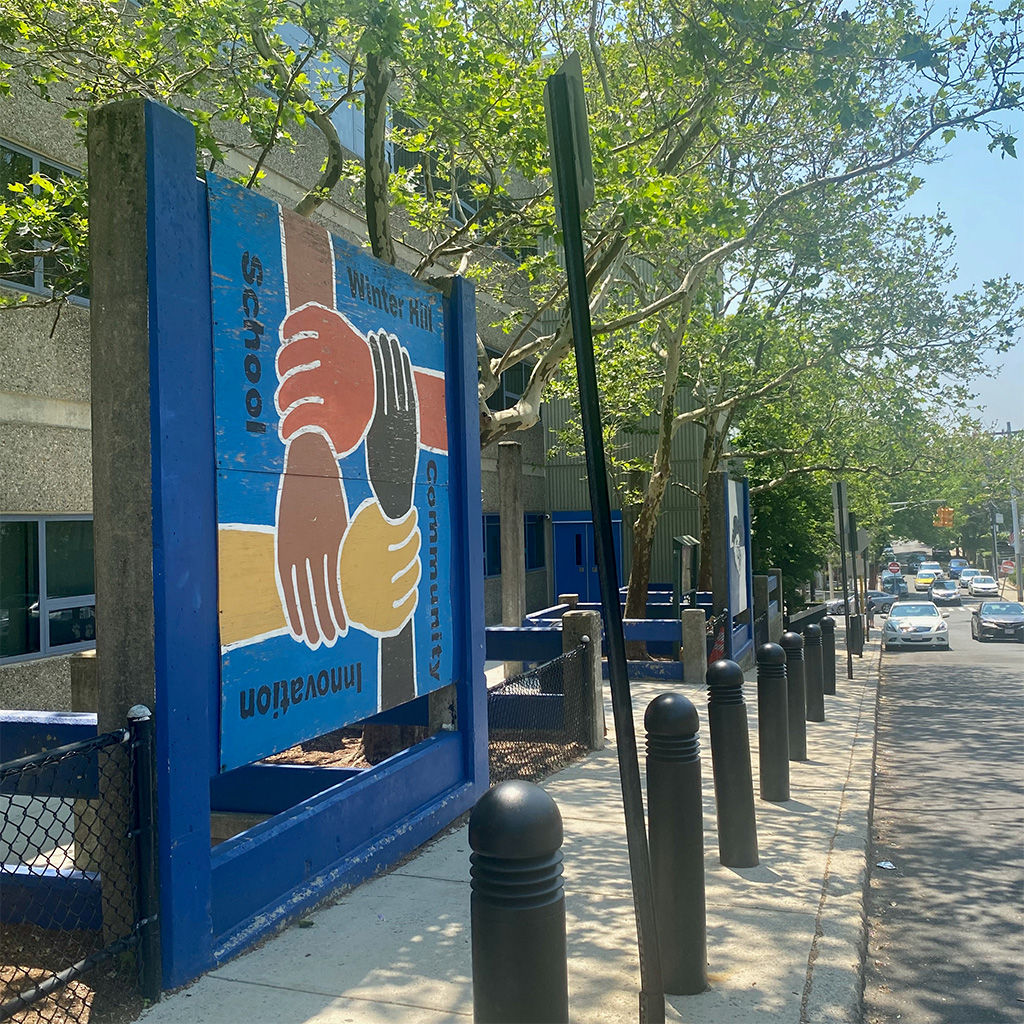
The City of Somerville is developing plans to build a new school building on the site of the former Winter Hill Community Innovation School at 115 Sycamore Street. This new facility will be a state-of-the-art educational center and a community gathering place to benefit students and their families for generations to come.
This spring, Superintendent Carmona and the school district will work closely with project managers, city planners, and the Mayor's office to complete the feasibility study, which includes two key documents - the Preliminary Design Program and the Preferred Schematic Report. In each instance, the School Committee will review and vote to approve these documents for submission to the Massachusetts School Building Authority (MSBA), the project's funding partner.
The City website includes a complete overview of the project, plus important documents and upcoming dates. The site is updated regularly as a vital resource for those following the New School Building Project. Residents can also sign up to receive a monthly project newsletter from the City.
For Project FAQs, please scroll down.
> HOW WE GOT HERE
In June 2023, the Winter Hill School on Sycamore Street was closed and the school was relocated to the Edgerly Building on Cross Street. A Construction Advocacy Group (CAG) was appointed by the Mayor's office to recommend a viable course forward on a solution, and late in 2025 the group issued its report. They concluded that the best course of action would be to build a new school on the site of the original Winter Hill building. The majority of CAG members supported building for the largest possible capacity (925 students) that the State would help fund. The scope of the project would therefore include relocating students and staff from the Brown School, the oldest school in the district, to the new facility at 115 Sycamore. Construction is currently expected to be completed in late 2031. Review meetings and documents from the CAG process at the City's website.
> WHAT'S NEXT
Work on the feasibility study will continue throughout Summer 2026 for a late August submission to MSBA. This fall, work begins on the Schematic Design, as the look and layout take a more detailed shape. During the entire process, project managers urge the community to participate in public forums and discussions to offer constructive feedback on the development. Additionally, the school district will identify opportunities to engage Winter Hill and Brown families directly, and those will be shared through SPS channels as well as directly through school communications. Upcoming community dates can be found at the City's website.
> FAQ: General
Why do we want to build for 925 students at 115 Sycamore Street?
Building a larger school means creating a modern learning environment with dedicated, purpose-built spaces that better support specialized programming and meet the needs of more students. The Construction Advisory Group (CAG) recommended pursuing the largest school size supported by the state because it maximizes opportunities for both the district and the broader community, and the district agrees with that recommendation. This approach allows for an expanded range of opportunities available to students through thoughtfully designed learning environments — including age-appropriate experiences across grade levels, dedicated spaces that support diverse learning needs, and areas designed for community use and programming. Project partners at Perkins Eastman and PMA Consultants bring extensive experience delivering similar projects in communities across the state. As part of this process, we are learning from successful models elsewhere while thoughtfully tailoring the design to reflect the unique needs, priorities, and character of Somerville and its students.
What does the planning process involve?
Projects of this scale must undergo a multi-year planning and design process before the start of construction. Additionally, the MSBA has a defined process to follow as well as a project timeline. It is important to note that we are currently on track and moving forward according to the MSBA’s timeline. A full outline of this process and timeline is available at somervillema.gov/newschool.
How will the school be paid for?
The City is currently working with the Massachusetts School Building Authority (MSBA) to obtain state funding. The MSBA would fund approximately half of the project, and the City would fund the other half. Even with funding from the state, the City will need to raise property taxes to pay for a new school, as it did for the new Somerville High School. This would require voters to vote to approve a property tax increase called a debt exclusion proposition 2 ½. We currently anticipate the vote on a debt exclusion would take place in the second half of 2027.
Will the public have input on this project?
Absolutely. The City, school district, and project developers are eager to hear feedback from the community through a variety of opportunities, including Community Forums and design workshops. These are announced via the City website and social media channels. Keep up to date by signing up for the City's project newsletter!
> FAQ: The Brown School Building
If the MBSA approves funding for a school to include the Brown population, do we still have to close the Brown School?
Accepting state funding to meet the student population needs of the Brown School means these student seats would need to shift to the new school building..
If the Brown population moves to the new school, will it still be called Winter Hill Community Innovation?
No, there is no intention to simply absorb the Brown School community into the Winter Hill school. The configuration and programming on the new school building needs to be the subject of extensive School Committee discussion on how we best meet the needs of our students and school community.
During the MSBA process, will maintenance and facility improvements continue at the Edgerly and Brown?
Yes, it is critical to ensure that both buildings can continue to serve our students through the completion of the new school building and beyond.
> FAQ: School Enrollment
How will the city address enrollment needs on the west side of Somerville if the Brown School building closes, including potential changes to catchment areas, school choice, and access to walkable neighborhood schools?
The closure of the Brown School building is not expected to reduce the district’s overall capacity, as those seats will be relocated to the new school at 115 Sycamore Street. However, the change will affect student assignment and family choice across the district as the School Committee reviews school boundaries, catchment areas, and the School District Street Directory. At the same time, the district’s school assignment and choice policies are being reviewed through discussions involving the School Committee, the Somerville Educators Union, and the Ad-Hoc School Assignment Advisory Committee. Any resulting policy changes could further impact student assignments citywide, including access to neighborhood and walkable school options. SPS has committed to prioritizing Brown and Winter Hill families for placement in the new school and will provide multiple opportunities for community input before any decisions are finalized. The district expects to share a timeline by Fall 2026 for reviewing and approving any assignment policy changes. The overall goal is to maintain adequate capacity, equitable access, and realistic school options for students and families across Somerville.
Will the city provide a new catchment plan for the entire city, and if so, how will this affect the other schools in Somerville? How does the city envision the future of school choice and walkability in Somerville?
The catchment plan will include considerations such as distance, access to specialized programs, family choice, and enrollment trends by grade. It is important to note that not every family selects their neighborhood school as their first choice for various reasons. In fact, approximately 44% of families did not choose their proximity school as their first choice for Kindergarten placement. The School Committee is convening a School Assignment Advisory Committee to guide a thoughtful, community-informed review of the district’s school choice and assignment policies. The City and School District share a commitment to safe and sustainable routes to school, including safe walking and riding routes. More information about transportation planning related to the new school project is available on the City’s webpage.
How does the city plan to provide a smaller school environment for children whose learning styles need and benefit from such an environment if both Brown and Winter Hill, two of Somerville’s smallest schools, no longer exist as small schools?
Consistent with educational models and the district’s Educational Program submission, the new school is being designed around smaller learning communities organized by developmental age groups: PreK–3, Grades 4–6, and Grades 7–8. These clusters will function as distinct student environments with dedicated administrative and support spaces while also benefiting from shared resources, expanded programming opportunities, and the flexibility a modern facility can provide. The goal of this model is to combine the benefits of a smaller-school experience with the academic, programmatic, and operational advantages of a larger school facility.